Mostrando postagens com marcador Jamila Salimpour. Mostrar todas as postagens

20 de janeiro de 2016

HISTÓRIAS DE MARIA - Minha Experiência com AS Pilares do Tribal

Conhecer as 3 Pilares da nossa dança, uma experiência que guardarei com muito carinho.

Carolena já tinha conhecido e estudado ao longo de 2015, quando fiz o General Skills com ela e Megha. Aqui, tivemos somente um pequeno (minúsculo) vislumbre de quem é realmente nossa Mamma C, em San Francisco (CA) o seu nível de descontração é aconchegante, você quase sente que pode falar, conversar, tocar, beijar sem ficar tenso (quase, porque eu sempre fico). Ao termino do meu primeiro dia de aulas intensivas no estúdio do FCBD® tive a ousadia de pedir por um vídeo do sorteio da primeira vaga para formação da Trupe que dançará com Kae... ela iluminou o rosto sorrindo e disse; claro, Maria. Fiquei em choque! Claro? Assim, tão fácil, pois é... desse jeito.
Após minha performance no ATS Homecoming, Carolena e eu

O comportamento dela durante essa semana que vivenciei diariamente de sua companhia e ensinamentos foi sempre acessível. A última aula, com a técnica do FLOW, foi emocionante, ela dançava no palco de costas pra nós e ao termino virou em lágrimas dizendo como uma menininha: esse é o melhor mês do ano, prometem que voltam ano que vem? Que aparecem para me visitar?

A sala de umas 200 pessoas ficou em lágrimas e rolou essa linda foto com todos ao lado da Mama.
Foto da última aula - encerramento do ATS Homecoming 2016
É uma sensação que não se consegue explicar com precisão, necessita vivenciar. Estar no ambiente e sentir.
Então, chegou do dia de conhecer a filha de Jamila Salimpour, Suhaila! Tentei muito encontrar Jamila, mas com quase 90 anos e com a saúde debilitada, não pode ir ao meu encontro. No entanto, Suhaila é a dinastia Salimpour, preserva seu legado e foi muito generosa comigo.  Conheci seu estúdio, cheio de referências a história de sua mãe e filha, dá pra ver um filme nas paredes, fui convidada a fazer uma aula (não deu pq a rotina do FCBD® era muito apertada e o estúdio ficava em outra cidade), ganhei presentes e conversamos muiiito. Encontro especial, jamais esquecerei. 

*Vi uma aula, Jesuuuuuuuuuus o que era aquilo!!! (coisa de gente grande). Lógico que mencionei a Carine e sua loucura por Jamila, alunos... e tudo mais, ela sorriu. Ficou muito feliz em saber do blog e de nosso trabalho recuperando o passado dessa dança.
Suhaila Salimpour - Estúdio Suhaila em San Pablo

Para coroar tantas emoções, afinal o blog existe por causa dessas fortes e incríveis mulheres. Chegou o dia, eu esperava, mas não tinha certeza que ocorreria, de conhecer MASHA!!!
Jesus quanta emoção, meus olhos marejaram na hora que a vi... ela me olhou e disse eu lhe conheço. Fiquei atônita, conhece? Sim, conheço... você não é a moça que curte tudo que eu posto? Eu sorri e disse SOU EUUUUUUUU.  Foi então que o mundo parou: - Eu vejo suas coisas, sei quem você é.

Oiiiiiiiiiiiiiiiiiiiiii????? Ahhhhhhhhhhhhhhhhhhhh, morri 1000x e arrumei coragem para voltar ao mundo dos vivos e ficar relembrando. Não é sempre que conhecemos uma pessoa que admiramos tanto e não nos decepcionamos.
Masha, eu te amo...você é a DIVA QUEEN DOS BADULAQUES!!!
Masha Archer, eu te amo!!!
Pronto missão cumprida... nossas Pilares todas aqui, representadas.
Xeros no pulsante.

20 de julho de 2015

JAMILA SALIMPOUR, BIOGRAFIA I

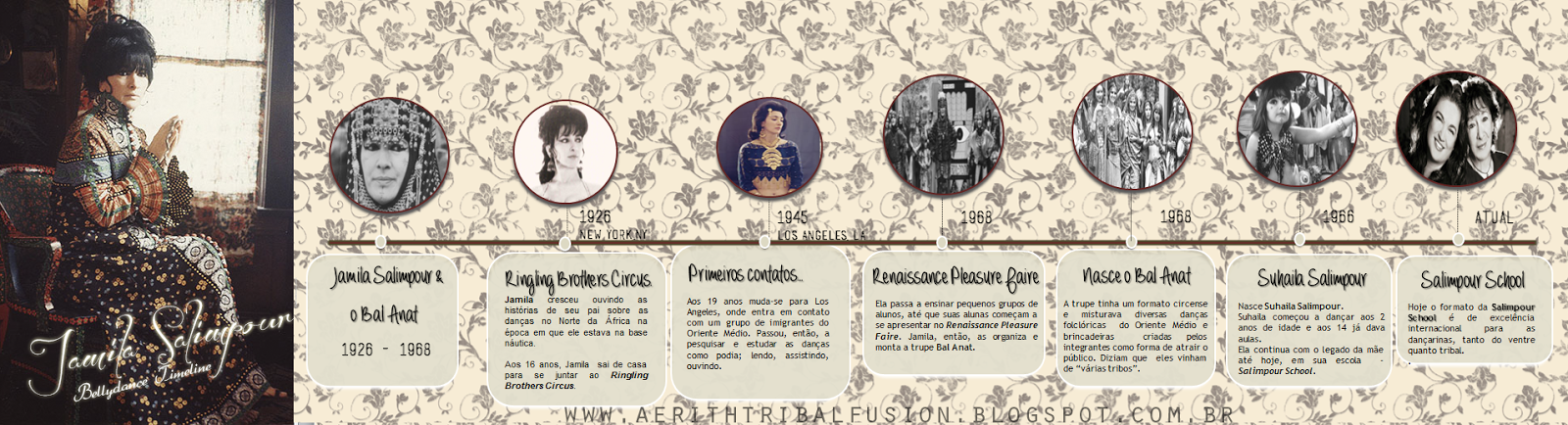
Jamila Salimpour nasceu em 1926.

Começou a dar aulas de dança em Berkley, em 1967. Quando viu o que suas alunas estavam fazendo no Renaissance Faire ela decidiu formar uma trupe mais disciplinada. Isto era para ser chamado de "Bal Anat" (Dança da Deusa Mãe). 

A partir de sua experiência no Ringling Brothers Barnum  e Bailey Circus ela elaborou um programa de variedades - que ela mesma descreveu como "metade reais e metade invenção". 

Infelizmente, muitas pessoas viram isso como "a dança do ventre real". 
E assim o início de "Tribal" surgiu.

A filha de Jamila, Suhaila dançou pela primeira vez em público aos três anos. Ela é agora uma dançarina e professora (do estilo cabaret), bem conhecida.

Jamila Salimpour é o criadora da dança do ventre tribal na América. 
Ela também é a primeira a solidificar um formato de terminologia na dança do ventre, que ainda hoje é utilizada. Foi a primeira professora de dança do ventre a criar um formato específico de movimentos, com nomes individuais para cada etapa. Seu formato foi a inspiração e fundamento do que mais tarde ficou conhecido como American Tribal Style

Os nomes dos passo muitas vezes originadas de pessoas que Jamila havia assistido pessoalmente, fazendo esse movimento. Por exemplo, Jamila nomeou oitos para cima e para baixo, de Maya, porque ela viu Maya Medwar fazê-los em um clube em Los Angeles na década de 1950Seu formato é ensinado e aplicado aos movimentos dos bailarinos em todo o mundo. Jamila é uma figura influente na dança do ventre há mais de 50 anos.


Jamila é também mestre em snujs, tocando diferentes padrões únicos e difíceis, muitas vezes experimentando com upbeat. Seu premiado CD instrucional também é uma grande ferramenta para o aprendizado dos snujs, e é utilizados nas classes do formato Jamila e Suhaila.

Nas aulas de Jamila, ela ensina o seu próprio formato de movimentos específicos e padrões snujs que ela tem ensinado durante décadas. 

A aula começa com a reprodução dos toques de snujs e então se move para a prática de movimentos em um círculo ao redor da sala. 

Esteja preparado para usar snujs durante toda a classe. 

Cada classe é diferente e de valor inestimável para o desenvolvimento de dança e para as habilidades com os snujs, além de aprender a história dos movimentos de dança do ventre na América. 

Jamila verdadeiramente é a matriarca Americana de dança do ventre.

** Tradução livre - Carine Würch **

Olhem este trabalho maravilhoso de Fernanda Lira e Aerith Asgard:
 
http://aerithtribalfusion.blogspot.com.br/2015/07/timeline-jamila-salimpour.html

14 de julho de 2015

CONTAGEM REGRESSIVA 2014-2015

Idealizadora: Maria Carvalho 

Postagens diárias feitas por Carine WürchNatália Espinosa e Maria Carvalho.


Pesquisa, Tradução e Compilação de Material feito exclusivamente 
pelo blog PILARES DO TRIBAL (todos os direitos reservados) 
Copyright © 


31ª Semana | 32ª Semana | 33ª Semana | 34ª Semana | 35ª Semana|

      41ª Semana | 42ª Semana | 43ª Semana | 44ª Semana | 45ª Semana |


      "Não subo no palco sozinha. 
      Aqui eu represento muitas. 
      Minhas antecessoras, 
      minhas matriarcas, 
      minhas companheiras de caminhada. 
      Sou UMA. Sou TODAS."  (Carine Würch)

      Textos:
      Nascimento do Bal Anat
      Timeline


      Pesquisa, Tradução e Compilação de Material feito exclusivamente pelo blog PILARES DO TRIBAL (todos os direitos reservados) Copyright © 

      10 de julho de 2015

      VÍDEO: Cabaret or Tribal? Com tradução!

      Este texto é uma tradução que fiz para um vídeo que Suhaila Salimpour disponibilizou no vimeo. Este vídeo, aparentemente, é para a divulgação de um workshop, mas possui muita informação legal!!

      Algumas notas sobre a tradução antes que você comece sua leitura:

      Aqui no Brasil, nós chamamos a dança do ventre tradicional apenas por dança do ventre, e o tribal de tribal, assim temos nossa divisão. Nos Estados Unidos, a dança do ventre é chamada de cabaret bellydance, pois ela era atração de cabaré mesmo. No texto, eu traduzi como estilo cabaré.

      Traduzi nightclubs como casas noturnas. Mas esses nightclubs não eram prostíbulos, só pra deixar claro!

      Boa leitura!
      Natália Espinosa

      Cabaret or Tribal? presented by the Salimpour School from Suhaila Salimpour on Vimeo.

      O link do vídeo: https://vimeo.com/131053852

      Jamila Salimpour foi influenciada pelas dançarinas das décadas de 30 e 40 e seus movimentos saíram desta era. Jamila era uma dançarina de casas noturnas e era proprietária de uma casa noturna, ela foi a primeira mulher a possuir uma casa noturna com temática árabe na Costa Oeste.

      Minha mãe ama música árabe e até hoje ela diz, e ela é bem enfática a respeito disso, que se você não está dançando uma música árabe, bem, você simplesmente não está dançando dança do ventre (risos). Minha mãe e eu às vezes discordamos sobre este ponto, mas eu amo música árabe completamente e eu entendo o que ela quer dizer, porque este era o amor dela e era – e é – a cultura e a música de onde vieram todos esses movimentos.

      Minha mãe dançava nas casas noturnas e mesmo antes disso ela dançou em todas as oportunidades que lhe foram dadas de se apresentar; não haviam casas noturnas quando ela dançava e, quando as casas noturnas de fato nasceram neste país, ela acabou dançando em casas noturnas, mas nessa época ela estava na casa dos 30! Minha mãe só começou a usar a palavra “Tribal” no fim da década de 60 quando criou o Bal Anat para a Renaissance Pleasure Fair. Até então, não havia separação, você não usava a palavra “cabaré” ou a palavra “tribal”; você era só uma dançarina de dança do ventre e você fazia de tudo. Então, o que definia uma aparência, uma sensação ou uma estilização era o ambiente do show, a hora do show – era um show de dia, um show à noite, um show para a família, uma casa noturna? – e isso criava a aparência, a sensação, o figurino,a energia... minha mãe estava tentando justificar a dança do ventre no contexto da Renaissance Fair então ela criou essa incrível fantasia tribal que sempre era apresentada como um Faz de Conta de Arte Performática, essa era até a palavra que ela usava, Faz de Conta, e era tudo ideia e fantasia dela.

      Mas a verdade é que a minha mãe sempre foi inspirada pela música árabe, ela queria representar e reconhecer e respeitar a cultura; ela criou os figurinos do Bal Anat a partir de fotos das National Geographics que ela tinha espalhadas pela casa, ela queria ter certeza que, apesar de estar tomando liberdades criativas em suas coreografias e na forma que o Bal Anat se apresentava, que tudo saía de pinturas, poesias ou essas revistas; ela estava tentando conseguir tudo o que podia para representar a cultura, porque não havia nada disponível...
      Mas todos os dançarinos do Bal Anat, de dia eles colocavam seus figurinos tribais e à noite eles colocavam seus figurinos de cabaré e trabalhavam em casas noturnas, não havia divisão na comunidade e o vocabulário de movimentos era todo igual, com apenas pequenas variações de movimentação e estilização baseadas na música, no clima e no figurino, mas o vocabulário de dança era todo do formato da Jamila Salimpour, que saiu dos dias de glória da Golden Era dos anos 40, daquelas dançarinas de dança do ventre estilo cabaré.

      Eu me lembro que quando eu comecei a trabalhar em casas noturnas, eu fui entrevistada por uma mulher que estava escrevendo uma matéria sobre o Legado Salimpour, e ela me perguntou: Quando você decidiu ser uma dançarina de dança do ventre estilo cabaré? E eu fiquei tão ofendida na época, porque eu nunca me classifiquei como uma dançarina de tribal ou de cabaré! Eu tenho muito orgulho de ser uma Salimpour, eu sou filha de Jamila Salimpour então eu levo dentro do peito o conceito de tribal e o que minha mãe criou; eu também trabalhava como dançarina e me sentia muito privilegiada que logo depois de terminar o ensino médio eu pude começar a trabalhar em casas noturnas e eu estava trabalhando com as melhores bandas e os músicos mais incríveis vindos do Oriente Médio, e me perguntaram quando eu -decidi- ser um a dançarina de estilo cabaré. Eu nunca decidi ser um ou outro! Eu era, e ainda sou, uma dançarina.

      Se você morava nos EUA, você foi tocado por Jamila Salimpour. Se você era um dançarino na Costa Oeste, você não foi apenas influenciado por Jamila Salimpour, você provavelmente estava dançando seu formato mesmo que não soubesse. Muitos dos alunos de minha mãe saíram da escola e começaram a ensinar por conta, e esses professores tiveram alunos, e esses alunos tiveram alunos, e posteriormente o termo tribal ou ATS® nasceu a partir de professores que foram alunos de Jamila Salimpour. Então o formato Jamila Salimpour foi a base para seus alunos saírem e ensinarem e isso se transformou em movimentos que mais tarde foram associados ao tribal, seja ATS® ou tribal fusion.

      O formato Jamila Salimpour nasceu da Golden Era, aquela época e forma de movimentação das melhores dançarinas dos anos 40, Badia Masabni, Tahia Carioca, e elas eram dançarinas de estilo cabaré, então os movimentos era associadas às melhores dançarinas vindas do Egito, naquela época. Então a base do que se tornou o tribal,ou ATS®, ou tribal fusion, é verdadeiramente o formato Jamila Salimpour. O Tribal Fusion, posteriormente, evoluiu a partir de alunos que saíram do formato Suhaila Salimpour, incorporando todos os movimentos de isolamento com contrações fortes, criados no fim da década de 70 e na década de 80. Então formato Suhaila Salimpour é agora associado a movimentos de Tribal Fusion.

      Jamila e Suhaila Salimpour são dançarinas de casas noturnas, e seus movimentos e musicalidade e a forma como representam a música árabe ainda possuem todos aqueles passos e todos os isolamentos.

      Se você tiver uma boa base de dança primeiro, você pode fazer tudo o que quiser. Você pode fazer escolhas artísticas, mas fazer qualquer estilização quer quiser. Esse workshop é para focar em técnica, para que você possa construir a base do seu movimento, a segurança e a postura, e então, mais tarde, você seja capaz de fazer escolhas criativas e artística. Eu quero que você seja capaz de fazer tudo isso. Eu quero que você seja capaz de crescer e evoluir através dos anos com uma base forte de técnica, de forma que, a medida que você mudar e crescer e seguir em frente com diferentes tipos de música e estilos, seu corpo seja capaz de se mover e evoluir com você.


      26 de junho de 2015

      CRIAÇÃO DO BAL ANAT


      Texto postado no Tribe Net, por Andre Khoury, pai de Isabella Salimpour (neta de Jamila Salimpour)

      A criação do grupo de dança Bal Anat começou em 1968, quando a oportunidade se apresentar em um festival ao ar livre chamado Renaisance Pleasure Faire, desafiou minha imaginação para criar um show de variedades, que se pode ser visto em um festival árabe Souk ou no Oriente Médio

      Era o formato que era admirado e imitado em todo o Estados Unidos, cujos praticantes às vezes sabiam, mas muitas vezes não sabiam qual sua origem. 

      De fato, muitas pessoas pensaram que era a "coisa real", quando na verdade metade era real, metade era invenção. 

      Pegando como inspiração meu passado, que incluia as danças com bailarinos que dançavam em taças, dançarinos com jarros e mágicos, treinei e apresentei muitas variedades de entretenimento, adicionando uma "surpresa" a cada ano. 

      Entre muitas outras coisas, até que em 1971, pus uma espada sobre a cabeça de Rhea Deanna Rose, a dança da espada nunca havia sido vista na América.
      Era para ser o primeiro, como aconteceu com muitas das danças do Bal Anat, que foram copiadas e exportadas para lugares desconhecidos. 

      A dança com espada, Dança com Jarros, Karshlama, Dança Marroquina, Ouled Nail, da Tunísia, Dança com Cobra, Dança Masculina com Bandeja, Dervish, Katak e a Dança com Máscara interpretada por Katrina Burda, eram originais naquele tempo. 
      Nunca vistos antes de 1968 na Northern Renaisance Pleasure Faire, são memorias que as pessoas trazem vivas até os dias de hoje. 

      Como o formato evoluiu, muitos dos meus alunos contribuíram com seus talentos coreográficos para a variedade do show, muitas vezes sugerindo adições, complementando a gama de Dança do Oriente Médio." (Jamila Salimpour 2001)

      22 de junho de 2015

      DISCURSO DE JAMILA SALIMPOUR

      Speech presented by Jamila Salimpour at the

      International Conference on Middle Eastern DanceOrange Coast College, Costa Mesa, CA
      May 16-18, 1997by Jamila Salimpour


      Hello and welcome to you all. I am honored to be here tonight and to be a part of the first International Middle-Eastern Dance Conference.

      In 60 minutes I am going to try to give you a glimpse into my journey with this dance. For those of you who already know me, you will hear my personal experience, and those of you who are just getting to know me, you will also get a look into the history of Middle-Eastern dance in America through my story. Please remember those were different times and I was struggling to create something that had never been done before, my love and passion for the dance always guiding me when there were no role models.

      My basic Oriental dance training come first from my father who was in the Sicilian Navy, stationed in the Middle East in 1910. His favorite pastime when in Egypt was watching the Ghawazee dance.

      Here is an excerpt from by father’s letter:
      "The first time I saw an Arabian dancer it was at Alexandria Egypt in 1910 on a corner of a public square on carpet – canvas like carpet. There were 3 players – one a clarinet, a chitar – a small type and a little drum I think. The dancer was bare foot, bare arms to the shoulder; bare back down to the curve of the buttocks – there a belt holding a tight fitting indumenta ending in strips of different colors half way to the legs. She had a large necklace made out of small disks of white metal probably tin – a row white and one yellow – probably gold gilded – kept together with their chains of the same color. These disks were about the size of a dime on top – distant one another one diameter – a larger size of disks down next row and so on – 7” or 8” long – 2 small cups for brazier that would came up from a garment held up from the belt in front leaving uncovered the front of the stomach – rings on both arms and forearms to the wrist 3 or 4 up and 6 or so below to the wrist. The twistings were to the music and the onlookers would throw money on the canvas. The party would scramble and the money would quickly get covered otherwise she would get pinched for it was performed in a public square. The English were there at the time and us sailors would feast our eyes for we liked to look at that type of dancing. When in Tunis or Algiers or … or Tripoli or … more or less it was all the same."

      When I was young he used to imitate them for us. In the late 40s my Egyptian landlady and I would go to the Egyptian movies every month. We saw many dancers, including Tahia Carioca and Samia Gamal. We would come home, put on Abdel Wahab and Farid Al Atrash records, and dance, trying to remember every move we'd seen. And so, from my father’s recollections, my landlady's firsthand knowledge, and from the movie’s examples, this was how I got my dance information.

      I first taught Oriental Dance in the early 1950s to old 78, three-minute Cife Telli records. Not having a dance vocabulary yet, I repeated the music as I improvised the dance. My students watched and imitated me, asking questions which often I couldn’t answer. I would just perform the dance again and again until they got it. Often, I would do variations on the theme, overlaying the basic movements, causing confusion, because I couldn’t break it down. Since I had never been taught the dance, I didn’t know how to teach the dance. There were no teachers, schools, or method that existed.

      From this background, I was ready at the beginning of the Arabic night-club craze, which erupted onto the scenes in the late 1950s. Whatever the catalyst, Americans were becoming curious about this dance and the music. Clubs sprouted in Hollywood. 1001 Nights on Sunset and Vine never made it. Hersheway’s, across the street from the Farmer’s Market, was short-lived. The Greek Village was the first club to open with its spontaneous weekend entertainment of dance-crazed Greek sailors. They didn’t want a belly-dancer for a long time. Then the Fez opened with an Egyptian trio featuring Siham, the cause of my marital break-up. She was the quintessential femme fatale. Her dance was indescribable. Shaker’s Oasis brought Turkish dancers from a club in Chicago.

      As business was beginning to boom, Middle-Eastern dancers were being imported to the clubs and I had the chance to watch show after show of technique. The repetition of the performers enabled me to observe a variety of movements which I mentally recorded and added to my repertoire. The majority of the dancers in Los Angeles were Egyptian style. There was Zenouba and Maya Medwar, who said she was trained by Ali Reda. Everyone wanted to dance like Maya. She was something to watch but not so easy to imitate.
      Jamila dancing at 12 Adler St., San Francisco 1960

      I commuted to dance in a club in Fresno, where Richard Hagopian played for me. I danced at the Greek Village, and had student nights upstairs at the Fez, where I begged Lou Shelby to let me dance, teach, and hostess. While he was thinking about it I was offered a job dancing at 12 Adler in San Francisco. The money was too good to turn down so I went to dance in San Francisco and never left. Eventually I owned the Bagdad Cabaret on Broadway, hiring musicians and dancers.

      It was only after I went to dance in San Francisco, where dancers were hired from different countries of the Middle East, that I saw a variety of styles. We worked in the same club and imitated each other’s specialties, of course, not in the same show, and usually only after they’d left town. Turkish Aisha wowed the audience with her full-body vibrations. During her show I would run to the dressing room to analyze her pivots. Soraya from Morocco danced almost always in a Beledi dress, balancing a pot on her head. Fatima Akef danced on water glasses with “Laura,” her parrot, perched on her shoulder. Nargis did the most incredible belly rolls and her entire finale consisted of continuous choo-choos. Fatima Ali did a 4/4 shimmy on the balls of her feet. I was told by Mohammed El Scali that she was an Ouled Nail. And so it went, show after show, night after night, year after year.

      Since the musicians were mostly amateurs, and from a variety of Arab countries, the music was haphazard. Rarely did they know the same piece, often going in different directions, and they practiced during the show. Rehearsals were unheard of. Musicians were in short supply so we couldn’t complain. You could replace a dancer easier than a musician.

      All of the musicals we danced to were in 4/4 rhythm with a waha-da-oh-noz for taqseem. Musicals like Aziza, with breaks and changes in rhythm, were then only played between shows.

      As I worked with and watched dancer after dancer, I would try to describe to my dancer friends some of the things I had seen that were different. When Tabora Najim come to town, it was the first time I had seen what I named the Turkish Drop and stomach flutter. Her veil work was unique and choreographed. She ended all her shows with an exciting Kashlama. Often a dancer would do a step and then do variations on a theme. If a movement was similar or related in some form, I categorized it as a family. I mentally catalogued as much as I could remember and included it in my format.
      Jamila at the Bagdad Cafe, 1962

      In Los Angeles, where Arabs made up a large part of the audience, the dance was short and in three parts: entrance, taqseem, and finale. Arabs came to hear the music and singer. In San Francisco, where you had a predominately American audience, they came to see the dancers. They didn’t understand Arabic so the songs meant nothing to them. A girl onstage brought the customers in, the owners would say, so now it was three dancers back-to-back, three shows a night.

      As time went on my specialty was to become a finger cymbal/shimmy solo which I performed without music, using my coin girdle as a percussion instrument, interspersing shimmy rhythms with finger cymbal variations. I mentally notated 4/4 shimmy, choo-choo, and ¾ shimmy while practicing my coin solo.

      1965 was a turning point in my career. While pregnant with Suhaila I began to teach full time. My performing career came to a complete halt the day I got married to Suhaila’s father. I was told that both my legs would be broken if I put one foot on the stage. I turned one of the rooms in our apartment into a studio and costume making salon. Not only was I teaching the dance but designing and making costumes as well. I remember having taught Bob Mackie’s wife to dance when he was a dishwasher in my restaurant, The Nine Muses. Bob and I had many creative adventures fixing her up for photo sessions and performances. We bought our first piece of assuit together on Olivera Street, which he made into a dress for me. We had no Madame Abla back then.

      Suhaila was born severely pigeon-toed, a condition inherited from her father’s family. When she began to walk she would trip over her feet. Children were very cruel and would make fun of her. I tried everything, including metal rods with special shoes. Nothing seemed to work. As a last resort I put her in ballet classes three times per week. The first position - turnout - exercises corrected the defect after a few years. Little did I know it was a blessing in disguise. Not only did her posture improve, but it gave Suhaila a body line soon to become characteristic in the new style of Middle Eastern dance.

      As Suhaila was growing up, so was the age of video. Now for the price of a video rental you could transport yourself to the hot night-clubs and hotels in the Middle East, seeing firsthand, the latest trends and movements. Americans were now able to tap into the Middle East and not just do our version or interpretation of the dance. This was a turning point in the Salimpour School. When Suhaila was 14 years old, teaching on her own with her trained body line, she combined her traditional training in my method with the new direction from Egypt.

      I began sponsoring dancers from Egypt, Morocco, Lebanon, Turkey and other countries-Ahmed Jarjour from Lebanon, Lala Hakim, Faten Salama, Shawki Naim, and Ahmed Hussein from Egypt, Bora Oskuk from Turkey, and Hassan Wakrim from  Morocco who taught Shikatt. Some of them were lead dancers with folkloric troupes. It was very important for me to have all styles available to my students. The dance was growing and so was our school. Although it wasn’t my specialty, I made sure to have all styles explored. One week I would have a Guedra workshop, the next week Suhaila would teach the choreography she learned from Nadia Gamal.

      Not only was the dance changing, but the music as well. It was no longer simply 4/4 but complicated musical compositions. A new wave of musicians from the Middle East was coming to America, and they brought the new music with them; Mahrajan, Mashal, Sit il Hassan, and many more dramatic opening musicals for a dancer’s show. Suhaila and I began to collaborate in a series of routines enabling the dancer to grow with the times. Once again my format took a turn. I was able to mold a blend of old style and new through my daughter’s body. We were always growing an feeling a sense of accomplishment.

      While Suhaila was assisting me with Oriental dance she was also studying ballet and jazz, and I watched every class. This enabled us to understand the direction of the dance interpretations of the new musical compositions. We choreographed to Mohamed Abdel Wahab, Abboud Abdel Al, Ahmad Fouad Hassa, and Farouk Slame, to name a few.

      I had a large amount of information accumulated and so I published a manual in 1978. I also catalogued finger cymbal patterns, releasing an audio tape with 24 patters and booklet with the history and notation of 47 patterns. I also invented loop tapes to teach Arabic dance.

      The dance began changing in America when Egyptian dancers visited, bringing their own orchestras. Sohair Zeki and Nagwa Fouad brought musicians who played complicated musicals which we had never heard before or danced to; Then we choreographed our first piece Joumana.

      As videos were being made available to us, featuring Oriental dance interpretations of modern musical compositions, the Reda Troupe, Sohair Zedi, Nahed Sabri, Hanan, Mona El Said, the dance in Egypt was evolving and the Russian presence was felt with the inclusion of ballet as a prerequisite to dance in the national folkloric companies. Members of these companies began choreographing for well-known cabaret dancers.

      The language that I developed enabled us to write down their choreography and teach it. From the ranks of these dancers have come some of the favorite performers and choreographers of our time. Many performers, formerly troupe members, were now doing solo cabaret. Others are choreographers we have heard of: Mohammed Khalil, Raquia Hassan, and Hassan Afifi, to name a few.

      As I catalogued each step that I had seen during my years on the stage, I began to categorize the movements performed by dancers from different areas of the Middle East, all of whom were trying to interpret Egyptian dance but had dance accents from their own countries. Fatima Ali from Algeria had a unique 4/4 shimmy which she executed on the balls of her feet. I teach that now as an Algerian shimmy. What I named the Turkish drop I credit to Taboura Najim. Basic Egyptian, a step pivot walk, was like a comma between steps for most dancers. The Arabic family with transitions One, Two and Three—variations on a one-foot shuffle were to be seen in almost all of the old-time Arab movies. Maya Medwar would do a figure eight from top to bottom as if being stuck between two walls. Maya has become a favorite step of dancers all over the world. Samiha was the opening step of the owner of the Club Ibis in New York. It was a horizontal ¾ shimmy with a hesitation moving from left to right. Zenouba was a zig-zag step which was done the reverse direction of running choo-choo.

      My next challenge was to put each step in order. It was the 60s and 70s and every teenager wanted to learn to belly-dance. It was important to me to structure a foundation for each dancer to be able to go from step one and progress. I didn’t want them to imitate my movements so much as I wanted to be able to put a name to a step, break it down, and when I wanted them to repeat that movement I would just call out the name.

      A former student, Debbie Goldman, wrote to me from Israel:
      “But you should know that my basic teaching method, my ABC technique is based on your method. Some of the movements I have obviously translated name in Hebrew. All my students, and generally dancers in Israel know ¾ shimmy, and they better know the difference between an up one and a down one! Maya has become a household word. It’s a real popular one! Sometimes I have girls call me saying how they can’t get it-and then I tell them why it’s called Maya, Basic Egyptian, 5-step, the Arabic family, etc…. The emphasis that you place on correct posture, in lengthening the lower spine and holding in the stomach muscles……We have two trends at the moment. One: is the studios and the serious students who are studying and improving and some start to perform, and two is the profession dancers and groups of girls from Eastern backgrounds who think because they are Moroccan or Iraqi or whatever, they don’t have anything to learn. So they buy and costume and start performing. In ethnic dance, there has always been a division between the folk dance of the people, and the more sophisticated professional style, and that the professional dancer has always been highly trained.”

      But, I want to backtrack now to the year 1967. Many of my students were disappearing from my Saturday classes. I was told that they were attending an event called the Renaissance Pleasure Faire, where, if you came in costume you got in free. In 1967 performances were spontaneous and whoever captured the stage could hold it for as long as they wished. People could and were performing along the road, gathering audiences, and causing congestion. The program director complained to me about all my students coming in costume, and performing all over the fairgrounds. She said it had to be controlled and gave the responsibility to me. We would be allowed three one-half hour performances a day and that would be it! We couldn’t go over or we would be out! I knew the cabaret format would not have been suitable for the Fair and that is when my Ringling Brothers Circus background came to the rescue.

      I patterned my dance troupe Bal-Anat, after a circus-like variety show which someone might see at an Arabian festival or a souk in the Middle East. It was a format with a look that was eventually imitated all over the United States, whose practitioners sometimes knew, but more often did not know, where it cam from. Indeed, many people thought it was the “real thing” when in fact it was half real and half hokum. Our leaflet informed the audience that we came from many tribes. Perhaps that’s where the expression “tribal dancing” originated.

      I created a variety show where each number was no more than three to five minutes long and represented a cross-section of old styles from the Middle East. We had two magicians, Gilli from Egypt, and Hassan from Morocco. I featured snake dancers, water glass dancing routines, and pot dances. Years before, Danny Reserva had given me a print by Gerome of the Sword Dancer and , copying the painting, in 1971, I had a student dance with a real Turkish sabre, balancing it on her head. For her finale she did a backbend and plunged the sword into the wooden stage where it stood upright as she retreated to make room for the next dance. That was, I believe, the first time the sword dance was seen in America. Suhaila at age 3 opened the show. We had a Ouled Nail dancer from Algeria, Kashlama dancers from Turkey, a Mother Goddess mask dancer, male tray dancers and the list goes on and on. We even had a Greek math professor from UC Berkeley who knew how to pick a table up with his teeth, all the while balancing Suhaila on top of it. The crowd went wild.

      Another first for me was the problem of music. Since the Faire would not allow recorded or amplified accompaniment of any kind, I had to search for an alternative. All the professional musicians I had worked with were not interested in getting up early, driving out to the boon-docks playing in the dust and worst of all not being heard or paid a decent wage. Only Louis Habib, fulltime barber and sometime oudist, volunteered to play for us “just for fun”. It wasn’t long before it wasn’t fun for him anymore. The oud was a delicate instrument which was easily over powered by drums. Not so with Mizmars. After teaching to mizmar taped music for a few years, I finally managed to collect a few of them, and began to ask craftsmen at the fair if they’d like to blow into the things. We always had craftsmen at the fair coming up to us asking if they could “sit in”. I wanted some structure but it was becoming hard to control. The first good, almost-Middle-Eastern sounding-mizmar player we got was craftsman/musician Ernie Fishbach, who dabbled in Indian music and had a Middle Eastern flair. He became the backbone of our Middle Eastern orchestra teaching enthusiasts who were willing to puff up their cheek for 30 minutes, three times a day. The ear-piercing hypnotic shrieks of several mizmars, with tabl belledi and multiple darboukas accompanying the dancers, became for many of our fans the sound of the fair.

      Tradition is not static. Every generation draws from the past. Evolving from the salon and street performer, to the night-club, and concert hall, whether its Belledi, Cabaret, or Folklore, the Oriental dance will endure.

      I have heard a couple of new expressions since my return to Berkeley. They are East Coast Tribal, West Coast Tribal, and the Ethnic Police, an expression I find very amusing. I don’t object to anything as long as it is entertaining.

      I am pleased that you honor me for my contribution to the dance and I am always happy when my method is shared. As you thank me for my format I want to thank all the dancers that have inspired me. 


      21 de junho de 2015

      Rest In Peace Phyllis Patterson - MISH MISH

      https://www.facebook.com/pamela.sklavosjaque/media_set?set=a.10152371289273670.1073741832.696738669&type=3

      Sharing a Phyllis Patterson Story.
      You probably don't know me by my birth name, most of you know or remember me as Mish Mish. I started Belly Dancing at Faire in 1972 with Jamila Salimpours Bal Anat. Then Southern & Northern with Pitu Guli / Babaganoush (Patty Farbers Group). Then in the 80's with Sage & the Bells for our Mullah (Don Brown) on Caravansary Stage. Then formed Gypsy Moor Dancers who later turned into Habi Ru.
      I had retired from dancing (1992) & formed an Andean Band playing traditional folkloric music & dance from So. America.
      I approached Lesley Patterson with an idea:
      That when Christopher Columbus set out for the New World, Pizarro discovered natives of So. America which they thought to be India.
      Bringing back some of these Indian dancers and musicians on their Spanish Galleons for King Ferdinand & Queen Isabella, their ships were attacked by the English and instead ended up being brought to Court for Queen Elizabeth's entertainment.
      The storyline was approved by Phyliss and 1994 we were hired for Northern Faire (Blackpoint) Caravansary Stage.
      Okay, that's the background.....Now, the Phyliss story:
      There's a very famous Andean Song written & composed at least a century ago called "El Condor Pasa". It was a collaboration by all the Andean Nations paying tribute to "The Last Inca". Its kind of like their National Anthem, loved by all its people.
      Well from time to time Phyliss would pass by and listen and watch the show. She loved it and its newness & storyline to Faire but one day approached me and politely asked me to "Please tell the musicians to stop playing that Simon & Garfunkel song"! "Its not Period"!!!!!
      Lol...laugh out loud...no one says "No" to our Fairey Godmother.
      So I very delicately had to explain to her the true history behind the song and how Simon & Garfunkel were inspired by it & only put lyrics to it.
      She still wasn't going for it and the song was respectfully taken out of the repertoire.


      20 de junho de 2015

      HISTÓRIA DA DANÇA DO VENTRE NOS EUA II (Jamila Salimpour)

      Texto postado no Tribe Net, por Andre Khoury, pai de Isabella Salimpour (neta de Jamila Salimpour)

      Quando chegou o dia para ver a famosa "Rosemarie", gravadores pesando uma tonelada, foram levados para o teatro. Naqueles dias, eram poucos os que poderiam se dar ao luxo de possuir um. Pegamos assentos no centro, de frente, bons lugares para um auditório, onde se sentam cerca de três mil. 

      Fomos cedo e as luzes ainda estavam acessas, assim olhamos em volta para ver quem estava sentado onde, antes do show começar. Era quase a hora de começar e, exceto pelo nosso grupo, havia cerca de vinte pessoas no balcão do teatro. Lá embaixo, havia um punhado de pessoas, e havia chegado do show começar. Esperamos, esperamos e esperamos, percebendo que algo estava acontecendo, e que talvez poucas pessoas compareceriam. Quando se tornou evidente que não haveriam mais pessoas, os que estavam no balcão concordaram em ficar no andar de baixo, mais perto da música. 

      Não me lembro muito sobre a dança de Rosemarie. Eu tinha mais ou menos 24 anos. Ela foi a primeira dançarina que vi em pessoa. Ela não tocava snujs. Tio Vahan disse que ela estava chateada quando ele gravou seu show, sem um acordo de antemão, e que precisaram negociar para que ele pudesse manter a fita. Zetrac a convidou para sua casa para uma noite musical, e fui apresentada a ela como uma aspirante a dançarina oriental

      A seu pedido, dancei para ela. Ela foi gentil em suas críticas sobre a minha "coreografia" e fez sugestões sobre meus braços, atitude e etapas. A única coisa que ela me mostrou, e que eu não poderia fazer, era uma figura de um oito indo devagar até até o chão e todo o caminho para cima novamente. Perdemos seu paradeiro, exceto por um breve visão dela em um clube recém-inaugurado na Sunset Boulevard, chamado de "Mil e Uma Noites", onde ouvimos que ela estava trabalhando. Eu nunca a vi dançar novamente.

      Houve outros programas Orientais de tempo em tempo. Um dos mais memoráveis foi de Shah Baroviano, um músico de tar, armênio persa, que se apresentou no Wilshire Ebell. Ainda posso ouvir sua bela versão de "Naz Bar". Parecia que todo o público cantava junto. Foi por volta de 1950 ou algo assim. De FresnoRichard Hagopian, um jovem virtuoso no Oud, estava sendo comparado ao grande Oudi Harant. Passariam mais alguns anos até que eu dançasse com sua música em uma boate em Fresno.

      Town and Country Market em La Cienega abaixo Melrose, tinha um restaurante Oriente Médio que tinha música e dança popular nos fins de semana, mas não havia dançarinas do ventre. Nós fomos lá algumas vezes, e nos juntávamos ao dabke, entre as mesas. 

      Haviam programas em que uma mulher chamada Khanza Omar, que fazia proezas, que precisávamos ver para crer. Dizia-se que além de ser uma grande dançarina, ela poderia fazer backbends maravilhosos e levantar cadeiras com seus dentes, levantando e continuando a dançar ao mesmo tempo, mantendo a cadeira entre os dentes. 

      Vídeo de Princess Raja, cerca de 1904, mostrando a dança onde as dançarinas seguravam a cadeira com a boca.


      Nos anos mais tarde, vi um documentário sobre bailarinos do Egito, que tinha uma sequência feita em uma tenda, do fora das pirâmides chamado The Balloon Café, ou algo parecido. Uma das dançarinas, vestida com Assuit da cabeça aos pés, e tocando enormes snujs, desceu até o chão em duplos shimmies, inclinou-se, ainda mantendo o tempo da música com seus snujs, e pegou uma mesa com os dentes, equilibrando-a alto no ar, enquanto dançava. Eu fui a uma apresentação da amada Khanza Omar. Para surpresa de todos, ela morreu no fim de semana antes de a comunidade árabe apresenta-la em um show chamado "ExtravaKhanza". Diziam que ela era uma princesa marroquina. Ocasionalmente, ela trabalhava como figurante em filmes. Outra dançarina Orientale chamado Delalah Mur, residia em algum lugar em Los Angeles, ensinava e tinha uma trupe. Nunca vi o ela dançando.

      Tinha por volta de vinte e seis anos, quando eu decidi aprender a tocar Oud. Encontrar um professor, era história aparte, e novamente tenho que agradecer Anoosh, por encontrar o Sr. Levonian, que estava disposto a me ensinar a tocar Oud. Eu queria muito aprender estilo egípcio, mas Levonian tocava o estilo turco. Mas era ele ou nada. Lembro-me dele reclamando sobre uma dançarina chamada Karoon Tootikian, que queria que ele compusesse uma música para ela. Incomodava-lhe que ela queria que ele colocasse a harmonia em sua composição, e ele diria que a nossa música é inocente, que ela deve deixá-la em paz! 

      Do que eu consegui reunir sobre sua dança, ela era uma dançarina folclórica armênia interpretativa. Ouvi que sua especialidade era um dervish rodopiante , o que era fácil para ela dançar, pois tinha uma doença ocular, que tirou sua visão. Uma vez, que ela calculou mal as dimensões do palco no Wilshire Ebell e, durante a apresentação de seu dervish, ela caiu no fosso da orquestra.

      De Boston, vieram histórias de dois clubes, onde o negócio foi crescendo: Khayyam Club Zarra, que tinha apresentações de música e dança do Oriente Médio.

      Histórias da briga em curso entre a cantora libanesa Morrocos e a impetuosa dançarina argelina Bedeah eram relatados semanalmente pela imprensa, que estavam sempre incitando, na esperança de criar uma briga. 

      Greek Village abriu em Hollywood Boulevard. Eles contrataram meus músicos, mas não queriam uma dançarina do ventre. Os proprietários eram da Costa Leste. A esposa do proprietário cantava e dançava um Cifte Telli em roupas de normais (não figurino). Tinham uma filha que se parecia com Sophia Loren. Ela usava blusas de corte baixo e acompanhava os músicos com um tambor de conga. Não importava se ela sabia tocar ou não. A visão dela, valia o preço da entrada.

      Tradução livre por Carine Würch